Section outline
-
These documents contain the same metrics, one in CSV table form, the other in graphical form.
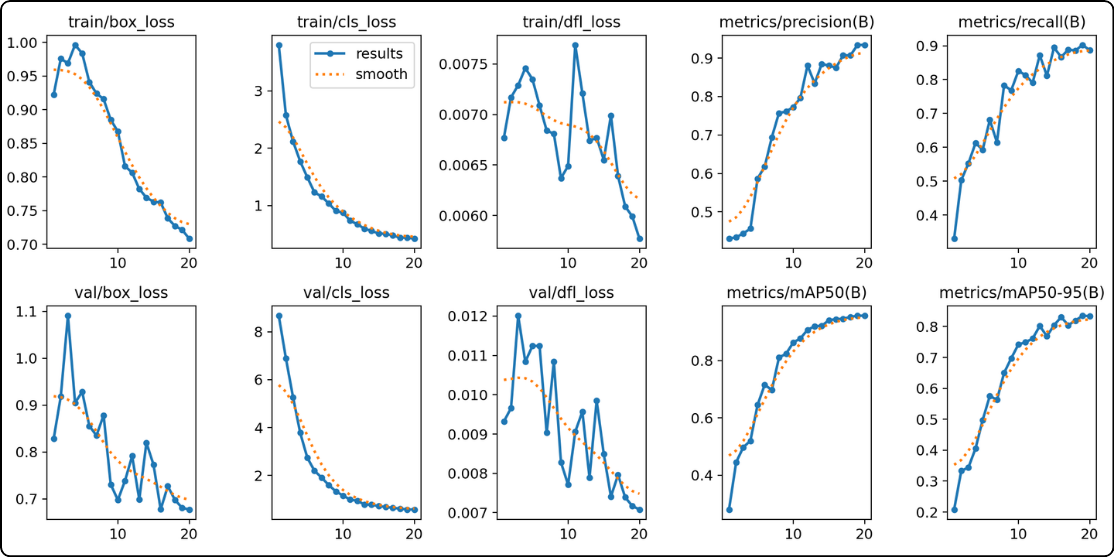
The result graphs are divided into two groups to evaluate the model's convergence and efficiency:
- the six curves on the left (the losses) : these indicate that the model is learning and making fewer errors.
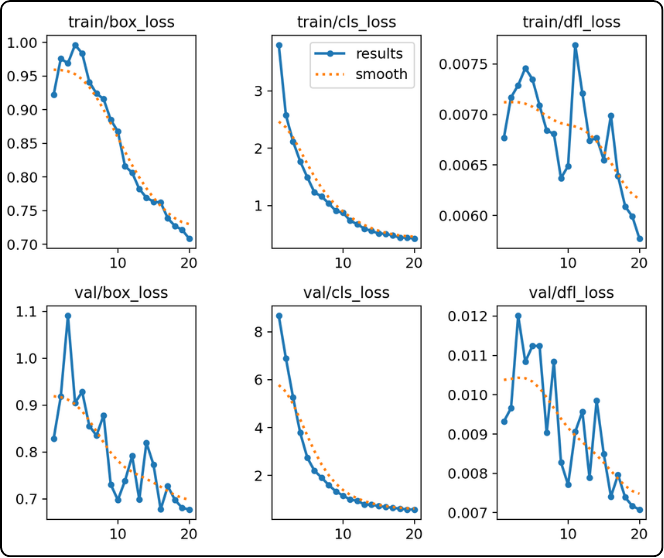
The metric curves (two columns on the right): Precision, Recall, mAP50, and mAP50-95 illustrate the model's increasing competence. The objective is to observe the progression of these curves until they reach a plateau. Stabilization indicates that the model has reached its maximum potential and that training can cease. Conversely, continuous growth suggests that extending the training is necessary.
- the four curves on the right (precision, recall, mAP50, mAP50-95) : these show that the model is becoming more performant.
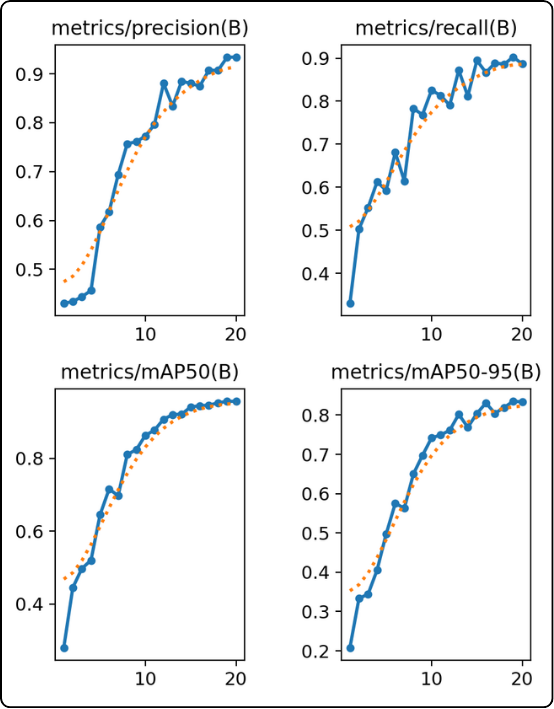
The loss curves (three columns on the left): These show the evolution of the error (loss) during training and validation. A simultaneous decrease in both curves is the ideal sign of a model that is learning correctly and generalizing its acquired knowledge effectively.
FOR FURTHER EXPLORATION
Overfitting occurs when the model memorizes the training data by heart instead of learning generalizable patterns. It then becomes incapable of performing well on new data.
- visual detection : this phenomenon is identified by a divergence in the loss curves. If the training curve (top) continues to descend while the validation curve (bottom) rises, the model is overfitting. The validation curve acts as a neutral witness, as the model does not train on these data.
- automatic management and resources : YOLO mitigates this risk by saving two versions: `last.pt` (the final state, potentially overfitted) and `best.pt` (the best weights recorded before validation degradation). Although `best.pt` guarantees performance, overfitting remains an unnecessary consumption of time and computational energy.
- optimization via the 'patience' parameter : to avoid this waste, it is recommended to use the `patience` parameter. This automatically stops training if no improvement is detected on the validation set after a defined number of epochs, ensuring that the process halts as soon as the model reaches its optimum.