Section outline
-
-
This tutorial outlines the methodologies pertaining to object detection and recognition within images. It details the training protocols for artificial intelligence models to ensure the identification of specific targets and their precise spatial localization through the use of bounding boxes.
A model trained to recognize fractures will yield the following result :

(Source : https://doi.org/10.1259/bjr.20200975)
So we will have a tool that is not only capable of locating something spatially but also of recognizing it.
SUPERVISED MODEL TRAINING
Training an artificial intelligence model for object detection relies on supervised learning. This approach requires submitting previously annotated images to the model, where subjects of interest have been delimited by human intervention, thereby providing the "ground truth" essential for the autonomous learning of object features.
The creation of these reference datasets necessitates a manual annotation phase, consisting of framing target objects with rectangles. Although laborious, this step is imperative. While annotated databases exist, their availability remains limited for niche domains, often rendering the creation of custom datasets necessary.
The model utilized in this context is the "YOLO" architecture, the technical specifics of which will be detailed later.
CONCEPT OF CLASS
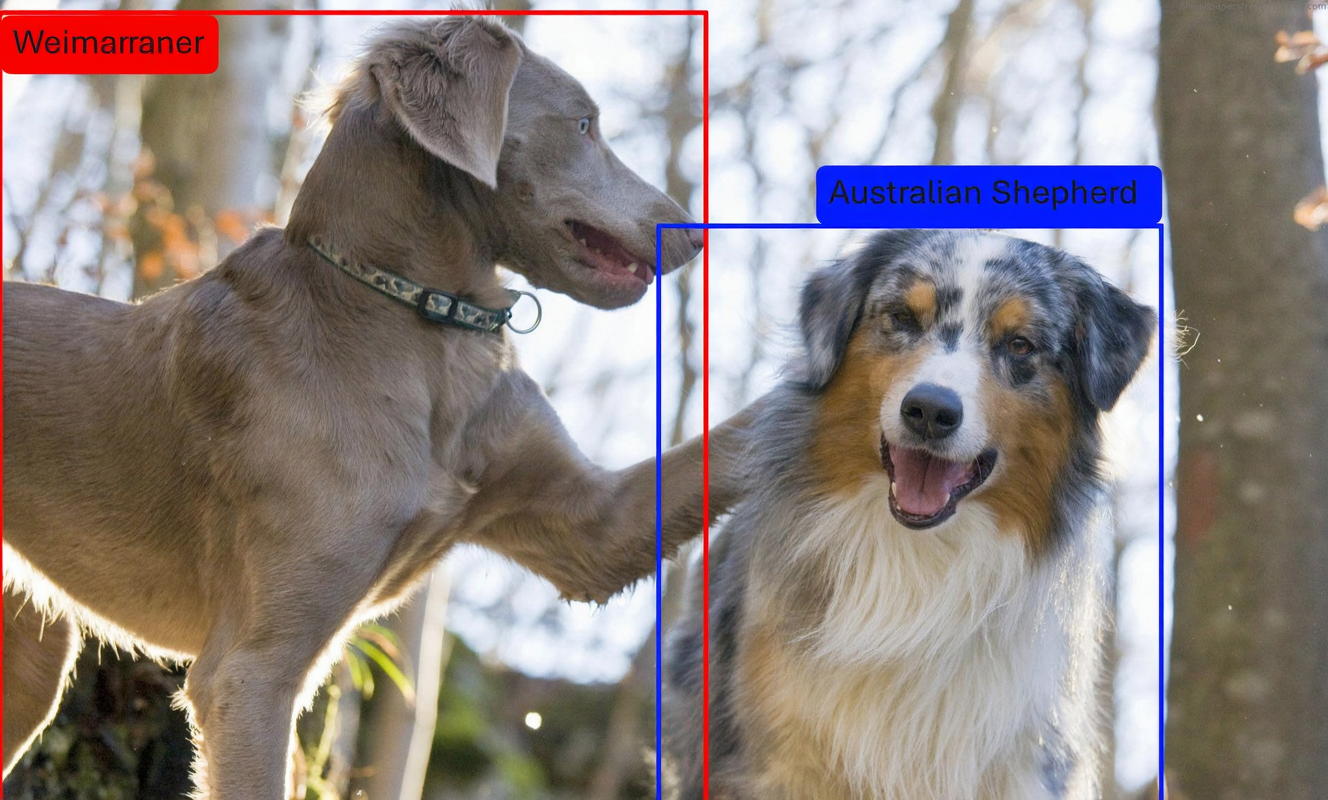
Subjects of interest must be associated with a label designating their category of belonging, termed a "class." This taxonomy offers total flexibility: it can be general (e.g., "cat," "dog") or highly specific (e.g., "Australian Shepherd," "Weimaraner"), depending on the detection objectives.
The term "class," recurring throughout this document, refers exclusively to the object categories targeted by the model.

DIVERSITY OF DATA
It is important to note that the efficacy of a trained model is intrinsically linked to the representativeness of its training data. For instance, a model specialized in detecting cats in snowy environments might fail to identify these same animals in a different context, such as a meadow. Consequently, the construction of the dataset must faithfully reflect the diversity of the deployment scenarios envisaged to ensure the system's robustness.

-